FaceKit, the face-rating app built by a 19-year-old — how ‘40 AI-generated influencers’ drove 100M views a month and $100k in 2 months with zero ad spend
A ‘scan your face and score it’ looksmaxing app built by 19-year-old Rafael Kramer: an iPhone TrueDepth 3D face scan quantifies symmetry and golden ratios. The growth engine isn’t human — it’s ‘40 AI-influencer accounts generated with Nano Banana.’ A few clippers mass-post them on TikTok, and 100M+ monthly views drove $100k in cumulative sales in two months with zero ad spend.
- Monthly (est.)
- $50k/mo
- Time to grow
- 2 months
- Users
- 100K
Key takeaways
- Generate the distributor itself with AI: make realistic avatars (fictional people) with Nano Banana and animate them into video with Sora, etc.
- Stand up dozens of ‘influencers who don’t exist’ (FaceKit ran ~40) and mass-post them on TikTok
- Coordinate a few clippers in a group chat and instantly copy any winning format across all accounts
The pain point, and how they found it
‘Objectively, how many points is my face?’ — for the Gen Z youth sinking into ‘looksmaxing,’ this is an urgent, repeating obsession. Until now there were only mirrors, other people’s subjective takes, or sketchy rating sites — nothing that returned, in numbers, ‘what exactly to fix to improve.’ FaceKit hit that gap: an iPhone TrueDepth 3D face scan measures interocular distance, symmetry, and various ratios, then translates them into a ‘score’ plus improvement tips (skincare, hydration, gym). The very anxiety young people feel daily — ‘what’s my face’s score?’ — was itself the market entry point.
Background & product
FaceKit (full name ‘FaceKit – 3D Face Analysis’) is a ‘looksmaxing’ app that 3D-scans and analyzes your face. Using the iPhone’s TrueDepth camera (the same sensor behind Face ID), it reads your face in three dimensions, measures interocular distance, symmetry, and various ratios, and returns an overall ‘face analysis’ with a score plus skincare and lifestyle improvement tips. It’s published by the founder’s own app studio, Mindmush, in iOS utilities/self-improvement.
It was built by Rafael (Raf) Kramer, 19. He runs Mindmush, a studio that ships apps solo and, per reporting, has produced 10M+ downloads across 50+ apps. FaceKit is one of them — but what drew attention was less the product than *how it was marketed*.
Kramer leaned on no human influencers and no paid ads. Instead, he generated realistic human avatars with the image tool ‘Nano Banana,’ made them talk and move with OpenAI’s video model ‘Sora,’ and stood up ‘influencers who don’t exist’ across ~40 TikTok accounts. A few ‘clippers’ ran those accounts, mass-producing before/after and viral short videos that together generated 100M+ views a month. The result, as reported: ~$100,000 in cumulative gross sales about two months after launch, with video production costing ~$2,000/month and net profit after Apple’s cut around $35,000/month. After the peak it cooled to roughly $17,000/month recently (TrustMRR).
In other words, FaceKit sold ‘an AI-made face (the product)’ using ‘AI-made faces (the influencers)’ — a very 2026 snapshot of indie development that runs generative AI on both the product and the distribution side.
Pricing
Free download. The in-app purchase “FaceKit Pro” is listed from $9.99 to $89.99 (per App Store; no billing period is shown and the same item appears at several prices, so neither the period nor a single price is asserted here).
Based in: Switzerland (Zürich)
App screens


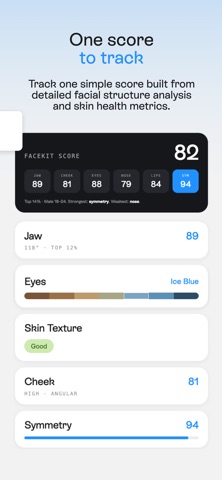

Images are served directly by the App Store / the product's own site (not rehosted here) — FaceKit
How it was built
- Read the face in 3D with the iPhone's TrueDepth camera (the same sensor as Face ID) and present eye spacing, symmetry and various ratios as measured values
- Use that 'measured, not guessed' credibility to separate the app from novelty and fortune-telling apps
- Design so the product's core value — scoring a face — doubles as the strongest possible thumbnail and hook
- Show the entry point free (a scan plus a rough score) and put detailed analysis and improvement suggestions behind weekly/monthly/yearly subscription tiers
- Don't try to hit with one app — ship from Mindmush, a studio that has shipped 50+ apps and 10M+ downloads and fires at volume
- What AI did
- AI builds not just the product but the distribution too — Nano Banana generates the avatars and Sora generates the talking videos
How it got users
- Synthesize the distributors themselves — generate photoreal avatars of people who don't exist with Nano Banana, then make them talk and move with OpenAI's Sora
- Keep about 40 of these nonexistent influencers permanently running on TikTok, collapsing what would be negotiation, fees and scheduling into generation cost alone (roughly $2,000 a month in production)
- Coordinate a handful of clippers over group chat and copy any winning format to every account immediately
- Spread accounts to blunt ban and stall risk while rolling out winners dozens of times faster than humans could (100M+ views a month at zero ad spend)
- Pick combustible subject matter — looksmaxing combines acute young-adult anxiety, self-reference and controversy — and ride a structure where a heated comment section drives more views
- Assume synthetic virality decays, and keep the factory running by refreshing formats, adding new avatars and switching subject matter
- Early ad spend
- $0 on both paid ads and human influencers — instead, roughly $2,000 a month in AI video production
The repeatable playbook
- 1Generate the distributor itself with AI: make realistic avatars (fictional people) with Nano Banana and animate them into video with Sora, etc.
- 2Stand up dozens of ‘influencers who don’t exist’ (FaceKit ran ~40) and mass-post them on TikTok
- 3Coordinate a few clippers in a group chat and instantly copy any winning format across all accounts
- 4Spread accounts against bans/stalls and fan winning angles out dozens of times faster than humans (100M+ views/month at zero ad spend)
- 5Pick a ‘flammable’ topic (looksmaxing = acute anxiety × controversy) and use the product’s core value (face scoring) directly as the video hook
- 6On the product, add ‘science-y’ credibility with real TrueDepth measurements; bridge free scan → paid detailed analysis into a subscription
- 7Assume synthetic virality decays — keep the ‘factory’ running by refreshing formats, injecting new avatars, and rotating topics
Channels they actually used
The hard parts
This case has a shadow side. First, durability — virality-sourced revenue is fickle and drops after the peak. After a stretch of ~$35,000/month in net profit, TrustMRR tracks it settling to roughly $17,000/month recently. Second, ethics and regulation — having ‘people who don’t exist’ recommend products as if real sits next to platform crackdowns on AI ‘slop’ and questions of trust. Behind the flashy launch numbers, a synthetic-influencer factory decays if left alone. Sustaining it takes the unglamorous work of ‘restarting’ — refreshing winning formats, injecting new avatars, rotating topics. It’s a lesson that launch force and staying power are different things.
Deep dive
【Deep dive】FaceKit matters less as a face-rating app than as an ad factory a 19-year-old built solo — one that replaced human influencers wholesale with generative AI. Here is Rafael Kramer’s method, taken apart step by step.
Core idea: synthesize the distribution channel itself. Classic UGC/influencer growth means ‘real human creators distribute for you.’ Kramer dropped that premise and generated the *distributors* themselves with AI. He made realistic avatars (fictional people) with the image tool ‘Nano Banana,’ then made them talk and move with OpenAI’s ‘Sora,’ standing up ‘influencers who don’t exist’ across ~40 permanent TikTok accounts. Where humans would need negotiation, fees, and scheduling, he collapsed it to generation cost alone — on the order of ~$2,000/month in production.
Decentralize × imitate: instantly copy one hit across 40 accounts. The 40 accounts are run by a few ‘clippers’ coordinating in a group chat. The crux is *instant lateral replication*: when a format (before/after, reaction, provocative hook, etc.) breaks out, everyone immediately clones that pattern on their own accounts. This (1) spreads the risk of any one account being banned or stalling, (2) fans a winning angle out across the surface dozens of times faster than a human could, and (3) learns which algorithmic hooks land, at many points simultaneously. The result: 100M+ views a month, at zero ad spend.
Topic selection: looksmaxing, a ‘flammable’ vein. The theme is part of the strategy. Looksmaxing carries young people’s acute anxiety, self-reference, and controversy — a ‘flammable’ subject where a heated comment section actually lifts reach. The hook ‘scan your face and get a score’ instantly triggers the viewer’s ‘what’s *my* score?’, shortening the path from video to install. The product’s core value (scoring) doubles as its strongest thumbnail/hook.
Product ‘plausibility’: put numbers on it with TrueDepth. Virality alone won’t keep people paying. FaceKit actually 3D-scans with the iPhone TrueDepth camera and presents symmetry and ratios as *measured values*. That ‘science-y’ feel (measured, not guessed) differentiates it from a mere novelty/horoscope app and bridges score-chasers into recurring subscriptions. Monetization is reported to use weekly/monthly/annual tiers — free at the door (scan + rough score), detailed analysis and improvement tips behind the paywall (we don’t assert this specific app’s exact prices here).
How the numbers were built — and their ‘seasonality.’ ~$100,000 cumulative gross in about two months, ~$35,000/month net profit. But virality-sourced revenue is fickle and drops once the peak passes — TrustMRR tracks ~$17,000/month recently. There’s an honest lesson here: an AI-influencer factory has spectacular *launch* force but decays if left alone. Sustaining it requires ‘restarting the factory’ — refreshing winning formats, injecting new avatars, rotating topics.
The studio behind it: Mindmush’s rate of fire. FaceKit isn’t a one-off stroke of luck; it came out of Mindmush, a ‘shoot-a-lot’ parent studio. Precisely because there’s a portfolio of 50+ apps and 10M+ downloads, a winning template (scan-style hooks × AI-influencer distribution) can be redeployed to the next app immediately. The moat accrues not in ‘the app called FaceKit’ but in ‘a distribution system that manufactures cheap mass exposure with synthetic influencers.’
The shadow side (worth stating): ethics and durability of synthetic growth. This method has a dark side: the propriety of ‘people who don’t exist’ recommending products as if real, platform crackdowns on AI ‘slop,’ and revenue instability from depending on virality. The takeaway for indie builders is clear: (1) generative AI can now collapse the cost not only of *building* but of *distributing* by an order of magnitude; (2) but assume synthetic virality decays — the real edge is the operational stamina to keep the factory running and to keep refreshing topics and formats.
FAQ
- What is FaceKit?
- A “looksmaxing” app that 3D-scans your face with the iPhone TrueDepth camera, measuring symmetry and ratios to return a score and improvement tips. It’s published by Mindmush, a studio based in Zürich, Switzerland.
- What country is FaceKit from?
- The publisher, Mindmush, is based in Zürich, Switzerland (confirmed via a founder interview).
Cross-case “growth playbook” report (coming soon)
We're building a paid report that aggregates every case in this database: which acquisition tactics worked, in which categories, and how well — insights you can't see from a single story. Get notified first when it launches.
Related cases
- Beauty & Self-improvementGlowUp
From ~10 Failed Apps to GlowUp — How a 24-Year-Old Solo Canadian Builder Used $0 in TikTok Ad Spend to Reach $800K in a Year and $1.2M ARR
GlowUp is a makeup app: upload a look you love, AI applies it to your own face and suggests the products to recreate it. After ~10 flops, Louis-David Paul-Hus launched it with $0 ad spend via TikTok and reached $800K in a year and $1.2M ARR.
12 monthsMonthly (est.)$100k/moTikTokShort-form videoInfluencer marketingInstagram - Health & FitnessCal AI
Built in High School at 17 — How Cal AI’s “Just Snap Your Food” Calorie Tracker Hit ~$50M ARR in 18 Months and Sold to MyFitnessPal
A photo calorie tracker built by Zach Yadegari and a teenage founding team: snap your meal and AI estimates the calories. Bootstrapped to ~$50M ARR and 15M downloads in 18 months, it was acquired by MyFitnessPal in 2025.
18 monthsMonthly (est.)$4.2M/moTikTokShort-form videoInfluencer marketingInstagram - LearningPingo AI
“Getting Roasted by an AI” Went Viral — How Pingo AI Hit $500K MRR in 14 Months on 200M TikTok Views
Two college roommates built an AI language tutor. Clips of the AI correcting users’ pronunciation racked up 200M+ TikTok views, taking it to $500K MRR (~$6M ARR) and 750K+ users just 14 months after launch.
14 monthsMonthly (est.)$500k/moTikTokShort-form videoInfluencer marketingMeme-driven