The Bank Only Gave Him PDFs — So a Hong Kong Solo Dev Turned That Annoyance Into a One-Page Tool Doing $40K/Month With Zero Ads, One Day a Week
Hong Kong solo dev Angus Cheng turned a simple annoyance — banks only hand you PDF statements — into a one-page ‘PDF statement → Excel/CSV’ tool. With zero ads, pure Google SEO, and one working day a week, it reached ~$40K/month (yearly revenue hit $318K in 2024) after launching in 2021.
- Monthly (est.)
- $40k/mo
- Launched
- 2021
 Angus Cheng@BallerIndustry
Key takeaways
- Pick one ‘boring, high-intent’ problem someone reliably Googles every month (it needn’t go viral)
- Productize your own pain (be user zero so spec and validation are self-contained)
- Make the tool itself the landing page for that phrase — lighter-to-maintain SEO than article farms
The pain point, and how they found it
Every month, accountants, bookkeepers, small-business owners and freelancers manually retype numbers from PDF bank statements into spreadsheets — because many banks (including Angus’s own HSBC) offer no Excel or CSV export, only PDFs. That boring, recurring pain of ‘copying a PDF into a spreadsheet by hand’ was exactly the entry point Bank Statement Converter aimed at. It isn’t flashy, but the key is that the affected people regularly Google for a fix — a pain with clear, high-intent search demand.
Background & product
Bank Statement Converter is a one-page web tool: upload a PDF bank or credit-card statement and it returns a clean Excel (XLSX) or CSV file. Its users are mainly accountants, bookkeepers, small-business owners and freelancers, automating the monthly chore of ‘copying a PDF into a spreadsheet by hand.’
It was built by Angus Cheng, based in Hong Kong. He has 14 years of engineering experience, previously at Credit Suisse (Assistant VP, APAC) and Block.one. The company is Dragon King Creation Limited, where he is the sole director, with no employees.
The trigger was his own frustration. His bank, HSBC, offered no Excel or CSV download — only PDFs. He wanted to analyze his spending but couldn’t get the data into a spreadsheet, so he wrote code to extract the numbers from the PDF and turned that into a product. The first user was himself — a textbook case of product–founder fit.
It launched in 2021. The original model was transactional (buy credits per statement scanned); it later switched to subscriptions. He barely used paid ads: most of the traffic comes from Google organic search (SEO). He went after the single, high-intent phrase ‘bank statement converter’ using the working tool itself as the landing page. On top of that, one of his blog posts reached the front page of Hacker News, earning backlinks and domain authority that accelerated the SEO further.
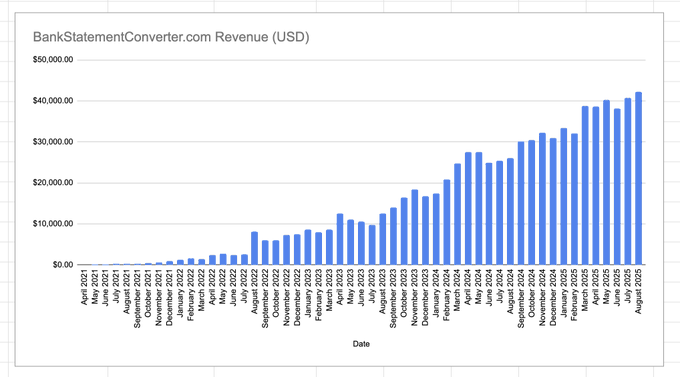
Today he runs it on roughly one day a week — handling support and bug fixes — a true lifestyle operation. And still it does about $40K/month, with yearly revenue reaching $318K in 2024.
From the founder (primary source)

Bank Statement Converter revenue by year. 2021 $3,181.72 2022 $49,427.67 2023 $147,336.55 2024 $318,112.61

Bank Statement Converter made $42,175 USD in August. #BuildInPublic
How it was built
- Productize your own pain — HSBC offered no Excel or CSV statement download, only PDFs, so the founder wrote code to pull the numbers out of the PDFs himself
- Make yourself the first user so the spec never wobbles and validation completes without anyone else
- Pick one boring problem with unmistakable search intent that someone reliably Googles every month — it doesn't need to go viral
- Make the tool itself the landing page for that one keyword — a single-page web tool needs far less maintenance than content-farm SEO
- Move billing from credits per page scanned to a subscription, turning the recurring needs of accountants and bookkeepers into a monthly revenue floor
How it got users
- Skip paid advertising and let organic Google search carry most of the traffic
- Claim the single high-intent keyword 'bank statement converter' by making the working tool itself the landing page — searchers already intend to buy, so there is no demand to create, only demand to harvest
- Compound investment into backlinks and domain authority — one blog post reaching the top of Hacker News lifted both and accelerated search rankings from there
- Choose against ads on the judgment that good content brings traffic for years and beats buying clicks
- Design for slow compounding measured in years rather than an 18-month spike — annual revenue went $3,182 in 2021, $49,428 in 2022, $147,337 in 2023 and $318,113 in 2024, with $10K MRR arriving about two years after launch
- Rely on the SEO moat of having accumulated domain authority and backlinks first to hold off the many near-identical copycat domains
- Early ad spend
- Effectively $0 — almost no paid advertising, with most traffic from organic Google search
The repeatable playbook
- 1Pick one ‘boring, high-intent’ problem someone reliably Googles every month (it needn’t go viral)
- 2Productize your own pain (be user zero so spec and validation are self-contained)
- 3Make the tool itself the landing page for that phrase — lighter-to-maintain SEO than article farms
- 4Skip paid ads; invest in backlinks and domain authority that compound (great content + Hacker News etc.)
- 5Shift pricing from transactional credits to subscriptions to turn repeat use into an MRR ‘floor’
- 6Design for slow yearly compounding, not an 18-month one-shot — runnable by one person, one day a week
The hard parts
Because this business is visibly profitable, many copycat sites have appeared on near-identical domains (bankstatementconverter.org, .online, bankstmtconverter.com, and more). Conversely, the original is partly protected by an ‘SEO moat’ — having accrued domain authority and backlinks first. A latecomer targeting the exact same phrase from scratch has to fight that already-compounded authority, which is worth bearing in mind.
Deep dive
【Deep dive】With no virality and no VC, a ‘boring utility’ compounded to $318K/year in the hands of one Hong Kong solo dev. This unflashy case may in fact be the most reproducible template for an indie builder. Let’s break it down.
Moat 1: Own one ‘boring, high-intent keyword’ with a one-page tool. The core of this business isn’t features or design — it’s owning the Google search for a single phrase: ‘bank statement converter.’ Anyone searching that already has strong purchase intent (‘I want my PDF statement as a spreadsheet’). You don’t need to *create* demand via blogs or social; you just harvest demand that already exists. And because the tool itself is the landing page, it’s lighter to maintain than article-farm SEO. Rather than chasing a flashy niche, pick one boring problem someone reliably Googles every month and own that phrase with a working tool — that’s the biggest moat.
Moat 2: Productize your own pain (be user zero). Angus wrote PDF-extraction code for himself, out of the frustration that HSBC only gave PDFs. So the spec never drifted, and validation was self-contained. His customer profile — accountants, bookkeepers, small businesses — was simply ‘people stuck with the same chore I had.’ Choosing a space where domain knowledge (ex-investment-banking) overlapped with a personal pain fueled both early traction and persistence.
Growth: Zero paid ads, all-in on SEO, plus a Hacker News backlink. He’s explicit that ‘good content brings traffic for years — more effective than buying clicks,’ and bet on SEO over paid acquisition. A turning point was one blog post hitting the front page of Hacker News; the backlinks and domain authority from that lifted his rankings and raised organic inflow thereafter. This compounding structure with zero ad spend is exactly why one person can hold $40K/month on one day a week.
Monetization: From transactional credits to subscriptions. At launch it was transactional — buy credits per statement scanned. That suits one-off use but makes revenue lumpy and hard to compound. Switching to subscriptions later converted the recurring needs of accountants and bookkeepers into steady monthly recurring revenue. Same product, but changing the pricing model built a revenue ‘floor.’
Timeline: Four years of slow compounding ($3,182 → $49,428 → $147,337 → $318,113/yr). The founder’s own X posts show yearly revenue of 2021 $3,182 → 2022 $49,428 → 2023 $147,337 → 2024 $318,113. Unlike 18-month viral rockets, SEO authority and subscription accrual push it up one step per year. It crossed $10K MRR in June 2023, roughly two years after launch — a ‘boring but strong’ curve where compounding slowly but surely wins.
Reproducing it — and a caveat: defend ‘first-mover authority’ in a copycat-ridden niche. Because this niche is visibly profitable, there are many copycat sites on near-identical domains (bankstatementconverter.org, .online, bankstmtconverter.com, and more). The flip side: the original, having accrued domain authority and backlinks first, holds a search-side ‘SEO moat.’ If an indie builder wants to copy the model, the order is: (1) pick one boring task someone reliably searches every month, (2) make the tool itself the landing page for that phrase, (3) invest in backlinks and authority (which compound) rather than paid ads, and (4) shift pricing from transactional to subscription to build a floor. It isn’t flashy, but here is the blueprint for a robust business that runs on one person, one day a week.
Cross-case “growth playbook” report (coming soon)
We're building a paid report that aggregates every case in this database: which acquisition tactics worked, in which categories, and how well — insights you can't see from a single story. Get notified first when it launches.
Related cases
- Developer ToolPostiz
Open Source as the Funnel — How Solo-Built Postiz 7x’d to $145K MRR in 4 Months by Selling to AI Agents
An open-source social-media scheduler built solo by Nevo David. A free, self-hostable repo is the top of funnel — 32K+ GitHub stars and ~6M downloads on a $0 ad budget. In 2026 he repositioned it as a tool for AI agents and 7x’d MRR from $21K to $145K in four months.
21 monthsMonthly (est.)$145k/moRedditProduct HuntX (Twitter)SEO - Developer ToolSenja
“Zero for the First Six Months” — How a 20-Year-Old and His Cofounder Compounded Senja, a Testimonial Tool, to $1M ARR With Two People and No Funding
A testimonial-collection tool built by Wilson Wilson and Olly Meakings — two people, no funding. Its free widgets spread the Senja name every time they’re embedded on a customer’s site; after six months at $0 MRR, it compounded to ~$83K MRR (~$1M ARR) and 3,000 paying customers in about four years.
46 monthsMonthly (est.)$83k/moSEOX (Twitter)Word of mouth - Developer ToolScreenshotOne
ScreenshotOne — How an ex-engineer’s “boring” URL-to-image API compounded to ~$200K–$300K ARR in 3 years on build-in-public and SEO alone
A screenshot API run solo by Dmytro Krasun: hand it a URL, get back an image — a deliberately boring developer tool. With no outside funding and almost no ads, he grew it on build-in-public revenue posts and technical SEO. Year one was $141/mo and near-death; three years later it serves 400–650 paying businesses at ~$200K–$300K ARR.
35 monthsMonthly (est.)$20k/moSEOX (Twitter)Reddit