After 18 Months of Failure He Borrowed $100K and Bet It All — How the “Snap a Photo, Type a Prompt” AI Editor Halo AI Hit $300K/mo in 45 Days
An AI photo editor by Dillion Verma (previously of Magic UI): upload a photo, type a prompt, and it edits the image. After 18 months of failed products he took a $100K personal loan and went all-in, then used one UGC video format and 85 creators to reach 1.2B views in 120 days — hitting $300K/mo with no VC in 45 days.
- Monthly (est.)
- $300k/mo
- Time to grow
- 2 months
 Dillion@dillionverma
Key takeaways
- Even at your quit line, if you hold one solid proof (e.g. a 6x-ROI hit), bet on the data, not a feeling
- Lock onto one winning UGC format and go deep (mass-produce it) before going wide
- Pay creators on view-milestone bonuses, not flat CPM, to align incentives
The pain point, and how they found it
“I just want to change this one part of the photo” is a near-universal urge, yet editing has long required pro software and skill — Photoshop is hard, and free apps look cheap. Halo AI erased that friction with ‘just snap it / just type it’: upload an image, describe the change in plain language, and the AI blends it back with natural lighting and texture. The very assumption that ‘editing is a professional’s job’ was itself the market entry point.
Background & product
Halo AI lets you upload a photo, type a prompt describing the change you want, and get an AI-edited image back. Swapping backgrounds, removing unwanted objects, adjusting how things look — all without pro software or retouching skill — is the core experience.
It was built by Dillion Verma, a developer previously known for Magic UI, a library of animated UI components he designed, built and sold. His personal site (dillion.io) lists several products, from an email-capture SaaS for GPT Store builders to an AI customer-support bot. In other words, Halo AI isn’t a lucky one-off — it’s the current waypoint of someone who keeps shipping.
The road wasn’t smooth, though. By his own account, roughly 18 months of failed products preceded Halo AI. His bank balance was nearly gone, and the one solid signal he had was a single data point: one TikTok video that returned 6x its ad spend. So he took out a $100K personal loan and bet everything on that winning format.
The payoff: using one UGC (user-generated content) video format and about 85 creators, he stacked 1.2 billion views in 120 days. With no VC and no traditional performance ads, he reached ~$300K monthly recurring revenue 45 days after launch. Technically, the image editing is reported to lean on Google’s Gemini image model (a.k.a. Nano Banana), with the paywall optimized via Superwall — a stack an indie builder can realistically reproduce.
Pricing
Free to download with in-app purchases: weekly subscriptions at $5.99–$8.99 and yearly at $29.99–$59.99, plus credit packs (300 credits $9.99 / 900 credits $24.99 / 2,000 credits $49.99). The price spread reflects ongoing paywall A/B tests.
Based in: United States (San Francisco)
App screens


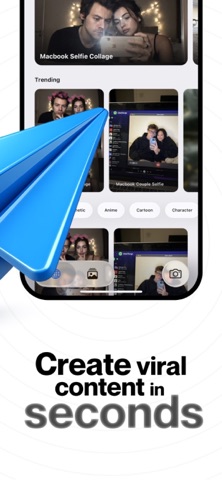

Images are served directly by the App Store / the product's own site (not rehosted here) — Halo AI
From the founder (primary source)
looks like i got tech twitter's attention a lot of people are in disbelief about the claim and tbh i would be too i started writing a post to answer all open questions ill let the suspense build until i'm finished the post 😜 AMA


i bootstrapped my first app from 0 to $300k MRR in 45 days no vc, no paid ads, no influencers
How it was built
- Run image editing on Google's Gemini image models (known as Nano Banana) rather than training a large model in-house
- Narrow the core experience to uploading a photo and writing a prompt for what to change — no specialist software, no retouching skill
- Drop gated onboarding and instead surface the paywall in line with the user's intent to edit right now (16.5% conversion)
- A/B optimize the paywall in Superwall
- Anchor pricing at $8.99/week across several tiers ($5.99-6.99/week, $29.99/year, credit packs), favoring adoption over ARPU
- What AI did
- Gemini image models power the core editing, and the Gemini API also transcribes and dissects winning videos to auto-generate briefs for creators
How it got users
- Even at the point of quitting, hold one hard data point — a single TikTok returning 6x ad spend — and bet on that evidence rather than instinct (taking a $100K personal loan)
- Lock onto the one UGC format that worked and mass-produce it vertically before expanding sideways (1.2B cumulative views in 120 days)
- Drive a network of ~85 creators on milestone bonuses at 20k/100k/500k/1M views rather than flat CPM — offered the choice, 29 of 30 picked the milestone deal
- Transcribe and dissect the videos that hit using the Gemini API, then pipe the findings into a Discord agent acting as a marketing coach so all 85 creators share the same winning angle
- Direct the $100K into performance-linked creator investment instead of managed ads, capping downside because a miss never triggers a large payout
- Early ad spend
- No managed ad spend — the entire $100K personal loan went into performance-linked creator payouts
The repeatable playbook
- 1Even at your quit line, if you hold one solid proof (e.g. a 6x-ROI hit), bet on the data, not a feeling
- 2Lock onto one winning UGC format and go deep (mass-produce it) before going wide
- 3Pay creators on view-milestone bonuses, not flat CPM, to align incentives
- 4Transcribe and dissect hit videos (e.g. with Gemini) into a distributable, repeatable brief
- 5Drop forced gating; A/B intent-based paywalls with Superwall to lift conversion
- 6Monetize thin-and-wide with weekly subscriptions ($8.99/wk etc.), adoption over ARPU
- 7Earn proof of a winning angle BEFORE you invest — don’t skip the order and start from debt
The hard parts
Roughly 18 months of failed products preceded Halo AI, and his bank balance was nearly gone. The $100K wasn’t savings but a personal loan — it paid off because the format worked, but a miss would have left only the debt. Behind ‘$300K in 45 days’ lies that long stretch of failure and a genuinely risky bet.
Deep dive
【Deep dive】Halo AI’s real reason for hitting $300K/mo in 45 days isn’t flashy tech — it’s that he believed in one winning format enough to borrow against it, then turned it into a repeatable machine. Step by step:
The setup: 18 months of failure and a $100K bet. Behind the headline numbers sat ~18 months of failed products. At the point most people quit, he could act not on a feeling but on one data point: a TikTok that returned 6x its ad spend. Many would dismiss a single hit as luck and move to the next idea; he read it the other way — ‘if this format is real, volume will scale it’ — and bet a $100K personal loan on it. The key is that he held *evidence of a winning angle* before betting. It wasn’t a blind upfront splurge.
Lock onto ONE UGC format and mass-produce it without drift. Growth came not from a buffet of tactics but from fixing one winning format and producing it relentlessly. Reinventing the structure, hook and framing every time scatters your learning; freezing the format narrows the only variable to ‘which input lands.’ With that single format he built the 1.2B-views-in-120-days denominator. The indie lesson is clear: when something hits, go *deep on the same format* before going wide.
Move 85 creators with view-milestone payouts. Distribution ran through a network of ~85 creators, and the lever was the comp design. Instead of a flat CPM (pay-per-1,000-views), he offered bonuses tied to view milestones (20k/100k/500k/1M) — and 29 of 30 creators reportedly chose the milestone model. Creators push harder because ‘the more it spreads, the more I earn,’ while the operator caps downside because ‘misses don’t cost much.’ Performance-linked pay is a device for aligning incentives between creator and founder.
Make hit videos reproducible with Gemini + a Discord agent. Rather than relying on individual taste, he reproduced winners systemically. Reporting indicates he used the Gemini API to transcribe and break down viral hits, then fed that into a Discord agent (a ‘marketing coach’ for creators) so all 85 could share the same winning formula. Converting personal skill into a *distributable brief* is exactly why it’s described as ‘turning 85 creators into one synchronized viral machine.’
Tighten paywall conversion with Superwall; monetize thin and wide. He converted the top-of-funnel into revenue via Superwall paywall optimization. Dropping forced gated onboarding in favor of intent-based paywalls — shown when the user actually wants to edit *now* — reportedly drove a 16.5% conversion rate. Pricing centers on $8.99/week across several tiers ($5.99–$6.99/week, $29.99/year, credit packs), prioritizing adoption over ARPU while still holding ~50% margins at $300K scale.
What ‘no ads’ really means — and a warning for copycats. He frames it as ‘no VC, no performance ads, no (traditional) influencers,’ but that doesn’t mean he spent nothing. He routed the $100K loan not into ad managers but into *performance-linked creator investment* — betting on a bonus-on-hit creator network instead of burning it in Meta Ads. And don’t forget the capital was *debt*. It paid off because the format worked; had it missed, only the $100K liability would remain. If you want to copy this, first earn the one piece of evidence he held before betting — a 6x-ROI signal of your own. Don’t skip the order and start from the loan.
FAQ
- What country is Halo AI from? Who built it?
- It was built by Dillion Verma, a developer based in San Francisco, US, previously known for developing and selling the UI component library “Magic UI.”
- How much does Halo AI cost?
- It’s free to download with in-app purchases: weekly subscriptions at $5.99–$8.99, yearly at $29.99–$59.99, plus credit packs (e.g. 300 credits for $9.99). The price spread reflects ongoing paywall A/B tests.
- What does Halo AI do?
- It’s a photo-editing app: upload a photo, type a prompt describing the change you want, and the AI edits and returns the image — swapping backgrounds or removing objects without pro software or retouching skill.
Cross-case “growth playbook” report (coming soon)
We're building a paid report that aggregates every case in this database: which acquisition tactics worked, in which categories, and how well — insights you can't see from a single story. Get notified first when it launches.
Related cases
- Health & FitnessCal AI
Built in High School at 17 — How Cal AI’s “Just Snap Your Food” Calorie Tracker Hit ~$50M ARR in 18 Months and Sold to MyFitnessPal
A photo calorie tracker built by Zach Yadegari and a teenage founding team: snap your meal and AI estimates the calories. Bootstrapped to ~$50M ARR and 15M downloads in 18 months, it was acquired by MyFitnessPal in 2025.
18 monthsMonthly (est.)$4.2M/moTikTokShort-form videoInfluencer marketingInstagram - Career & JobsSprout
Sprout, the “Tinder for jobs” built by a non-engineer in college — betting on distribution over building to reach $250K MRR in 8 months
A job-search app built by Nicole Cheung while at Claremont McKenna: swipe to apply, AI tailors a resume and cover letter per role, and an agent auto-submits on the employer’s site. With no ads and no VC it hit $250K MRR in 8 months — reusing the same creator-army playbook behind her earlier beauty app Glam Up (1M users in 6 months).
8 monthsMonthly (est.)$250k/moTikTokInstagramYouTubeShort-form video - Beauty & Self-improvementGlowUp
From ~10 Failed Apps to GlowUp — How a 24-Year-Old Solo Canadian Builder Used $0 in TikTok Ad Spend to Reach $800K in a Year and $1.2M ARR
GlowUp is a makeup app: upload a look you love, AI applies it to your own face and suggests the products to recreate it. After ~10 flops, Louis-David Paul-Hus launched it with $0 ad spend via TikTok and reached $800K in a year and $1.2M ARR.
12 monthsMonthly (est.)$100k/moTikTokShort-form videoInfluencer marketingInstagram