Sprout, the “Tinder for jobs” built by a non-engineer in college — betting on distribution over building to reach $250K MRR in 8 months
A job-search app built by Nicole Cheung while at Claremont McKenna: swipe to apply, AI tailors a resume and cover letter per role, and an agent auto-submits on the employer’s site. With no ads and no VC it hit $250K MRR in 8 months — reusing the same creator-army playbook behind her earlier beauty app Glam Up (1M users in 6 months).
- Monthly (est.)
- $250k/mo
- Time to grow
- 8 months
Key takeaways
- Design distribution before building — treat audience, not features, as the binding constraint
- Pick a category that combines a universal self-improvement need, short-form ‘watchability,’ and willingness to pay for the outcome
- Run UGC creators through a four-step loop: source → train via an in-house course → improve via feedback → mass-produce via referrals and analytics
The pain point, and how they found it
For new grads and early-career seekers, job hunting is the hell of re-typing the same facts dozens of times: filling out endless Workday forms per posting and rewriting a resume and cover letter for every role — one application drains you, so volume never happens. Sprout targets that application friction directly: swipe on a job you like, AI generates role-tailored documents, and an agent fills and submits the application on the employer’s site for you. The ‘job-hunt grind’ students know best was itself the market entry point.
Background & product
Sprout calls itself the ‘Tinder for jobs.’ You swipe through millions of roles; for the ones you like, Sprout matches your profile against the posting, asks a few focused questions to fill in gaps, and generates a resume and cover letter tailored to that specific job. Once you approve (or skip review), an AI agent fills out and submits the application on the employer’s own site. Everything that usually scatters across tabs is collected into one dashboard.
It was built by Nicole Cheung — a self-described ‘4x founder’ who launched several consumer AI apps with no formal engineering training while a student at Claremont McKenna College (Class of 2025, a double major in psychology and economics). Her first hit was the beauty app Glam Up: upload a selfie and AI analyzes your face and color season, then returns makeup advice and product picks. Her co-founder there was Aaron Paul, a Y Combinator–affiliated engineer. Within six months of its April 2024 launch — with zero ad spend and no outside funding — Glam Up passed one million users, hit #3 on the App Store, and reached $150K MRR.
Sprout (formerly Prep AI) ports that winning formula into a new category. Cheung’s thesis is blunt: now that ‘anyone can build an app in a weekend,’ the real constraint has shifted from shipping features to acquiring an audience. So with Sprout she treated distribution itself as the thing to engineer, as much as the product. Pricing comes in three tiers — Basic, Pro, Ultra — capped by applications per month, with monthly billing roughly 25% cheaper than weekly, and a subscription required to use it for real.
About eight months after launch, Sprout reached $250K MRR. Together with Glam Up, two apps were generating on the order of $400K a month combined — built without ads or venture capital.
Pricing
Free download. In-app purchases come in three tiers as of Aug 2026 (per the official pricing page): Basic $19.99/week, Pro $39.99/week, Ultra $79.99/week. Monthly billing runs about 25% cheaper than weekly.
Based in: United States (San Francisco)
App screens


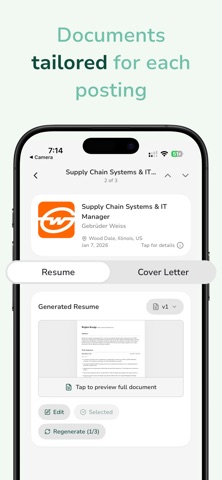
Images are served directly by the App Store / the product's own site (not rehosted here) — Sprout
How it was built
- Treat distribution, not building, as the binding constraint, and design it with the same intensity as the product
- Pick a category where three conditions meet — a universal self-improvement need, short-form video appeal, and strong motivation to pay for the outcome (porting the play from Glam Up in beauty to Sprout in job hunting)
- Erase the most draining part of job hunting, re-entering the same information: compress it to three moves — swipe, AI generates a resume and cover letter for that specific role, an agent fills in and submits the company's application form
- Consolidate scattered application status into a single dashboard
- Price in three tiers (Basic/Pro/Ultra) capped by monthly applications, making monthly about 25% cheaper than weekly to pull users toward long-term use
- What AI did
- No frontier model of their own — existing AI is translated into a frictionless experience, with differentiation placed in the distribution machine rather than the technology
How it got users
- Build a four-stage system that recruits and trains a pool of 200+ UGC creators
- (1) Sourcing — gather creators; (2) Onboarding — teach the winning angle through a structured in-house course
- (3) Management — improve each creator's posts through a feedback loop; (4) Optimization — pair referral incentives with an analytics stack so volume and quality rise together
- Codify the winning angle until more than half of course graduates land a viral video within their first two weeks
- Build volume from many small hits rather than sporadic virality — 400M views in a single week at peak, and 400-500M a month across TikTok, Instagram and YouTube since
- Port the distribution machine built for the first app (Glam Up) straight into a second app in another category (Sprout), accumulating the moat in the system rather than in any one app
- Early ad spend
- $0 — zero ad spend and zero outside capital, consistent since the previous app Glam Up
The repeatable playbook
- 1Design distribution before building — treat audience, not features, as the binding constraint
- 2Pick a category that combines a universal self-improvement need, short-form ‘watchability,’ and willingness to pay for the outcome
- 3Run UGC creators through a four-step loop: source → train via an in-house course → improve via feedback → mass-produce via referrals and analytics
- 4Codify the winning angles so graduates hit fast (aim for the bar: a majority go viral within two weeks of onboarding)
- 5On the product, collapse the most draining task into one swipe (for jobs: kill re-entry with AI generation + agent auto-apply)
- 6Tier pricing by usage with monthly/weekly options; show value first, then convert (psychologically well-timed monetization)
- 7Port the distribution playbook from app one into a different app-two category so the moat accrues in the *system*, not the app
The hard parts
Cheung has no formal engineering training and built several apps before landing on the jobs space (she calls herself a ‘4x founder’). She originally felt something was missing in a real-estate job, went traveling across Europe, then ended up in San Francisco building apps. Sprout wasn’t a first-try jackpot in jobs — it was the *second* app to re-run the distribution playbook she’d learned on Glam Up. The essence is reusing a system, not a single flash of inspiration.
Updates since publication
- Aug 21, 2026
Pricing updated: weekly Basic/Pro/Ultra tiers are now $19.99/$39.99/$79.99 (at publication, under the old Prep AI branding, they ranged $5.49–$29.99). Confirmed via the official pricing page and multiple independent reviews.
Deep dive
【Deep dive】Sprout matters less as a job app than as a distribution machine that turns virality from luck into process. Here is the system Nicole reused across two apps, taken apart.
Core idea: the constraint moved from ‘building’ to ‘distributing.’ Cheung’s consistent claim: in an era when anyone can build an app in a weekend, what decides the winner is not features but audience. So she engineers distribution with the same intensity as the product. The conclusion she earned with Glam Up — that with zero ads and no funding you can still reach a million users if you systematize distribution — she simply re-ran with Sprout. It’s the inverse of ‘build it well and they’ll come’: decide how you’ll spread it first, then build.
The four-step creator system (a factory for virality). The heart of Sprout’s growth is a machine that *trains* and runs 200+ UGC creators. The reported shape has four stages: (1) source the creators, (2) onboard them through a structured course — effectively an in-house school that teaches the winning angles, (3) manage each creator with feedback loops to improve their posts, and (4) optimize with referral incentives and analytics so volume and quality compound. The effect shows up in the numbers: more than 50% of creators who complete the onboarding course put out a viral video within their first two weeks. Sporadic virality became a repeatable supply line.
The resulting reach. When the factory runs, it hit a peak of 400 million views in a single week, and it still sustains 400–500 million monthly views across TikTok, Instagram, and YouTube. The key is that this is not one mega-hit but the sum of many small wins: more creators means more supply, and referrals pull in the next creators — so headcount itself becomes the next wave of acquisition, a positive loop.
Product-side friction removal: collapsing an application into one swipe. Distribution alone doesn’t keep people paying. On the product side, Sprout ruthlessly stripped out application friction. The per-posting Workday gauntlet, the per-role resume and cover-letter rewrites — that whole chain is compressed into three moves: swipe, AI generation, agent auto-fill. Erasing the most draining part of job hunting — re-entering the same information — is what justifies a recurring subscription.
Pricing and monetization design. Three tiers — Basic, Pro, Ultra — capped by applications per month. Monthly billing is ~25% cheaper than weekly, nudging committed users toward monthly. And because real use requires a subscription (you can finish onboarding, but you must pay to actually apply at volume), the funnel shows value first, then charges. The behavioral-psychology and ‘emotionally well-timed monetization’ that shaped Glam Up runs underneath this too.
Why the jobs category (the cleverness of genre choice). Beauty (Glam Up) to jobs (Sprout) looks like a leap, but the aim is consistent. Both have (a) a near-universal self-improvement need, (b) short-form ‘I tried it’ content that pops, and (c) strong willingness to pay for the outcome. To distribute via a creator factory you want a theme that’s easy for UGC to mass-produce and fast for viewers to see themselves in. Job hunting fits exactly — and pairs naturally with student creators.
The takeaway for indie builders. Sprout’s lesson is ‘a distribution moat over a technology moat.’ Rather than training a frontier model yourself, translate existing AI into a frictionless experience (minimizing the build-side differentiation) and instead invest in a repeatable distribution asset: a trained, self-replenishing creator engine. The distribution playbook built for app one worked unchanged in app two’s category — meaning the moat had accrued not in ‘the app’ but in ‘the system for distribution.’
FAQ
- What country is Sprout from? Who built it?
- It was built by Nicole Cheung, based in San Francisco, US — a self-described “4x founder” who launched several consumer AI apps while at Claremont McKenna College.
- How much does Sprout cost?
- It’s a free download with in-app purchases. As of Aug 2026: Basic $19.99/week, Pro $39.99/week, Ultra $79.99/week — monthly billing is about 25% cheaper than weekly.
- Can I use Sprout for free?
- Downloading and basic job browsing are free, but full use of AI-generated application documents and auto-apply requires a paid subscription.
Cross-case “growth playbook” report (coming soon)
We're building a paid report that aggregates every case in this database: which acquisition tactics worked, in which categories, and how well — insights you can't see from a single story. Get notified first when it launches.
Related cases
- Health & FitnessCal AI
Built in High School at 17 — How Cal AI’s “Just Snap Your Food” Calorie Tracker Hit ~$50M ARR in 18 Months and Sold to MyFitnessPal
A photo calorie tracker built by Zach Yadegari and a teenage founding team: snap your meal and AI estimates the calories. Bootstrapped to ~$50M ARR and 15M downloads in 18 months, it was acquired by MyFitnessPal in 2025.
18 monthsMonthly (est.)$4.2M/moTikTokShort-form videoInfluencer marketingInstagram - Health & FitnessStella
Audience First, Product Second — How a 4.5M-Follower Creator Used AI (Without Writing a Line of Code) to Take Manifesting App Stella to ~$300K MRR in About Two Months
Immigrant creator Sarah Perl (@hothighpriestess) built Stella with AI (Claude Code / Cursor) despite not being able to code, on top of the 4.5M-follower manifesting audience she’d spent years building. It hit ~$275K–$300K MRR and 12,000 paying subscribers in about two months — a textbook ‘distribution-first’ case.
2 monthsMonthly (est.)$275k/moTikTokInstagramShort-form videoInfluencer marketing - Socialnomadtable
Built Solo by an Ex-Amazon Engineer — How nomadtable Turned Solo-Travel Loneliness Into 2M Users and $2M ARR in Two Years
A meetup app for solo travelers built single-handedly by Jay Raavi: it matches you with nearby travelers in real time so you can meet up through activities and group chats. Fully bootstrapped (no team, no VC), it hit 1M downloads and $65K/month in under a year, then grew to 2M users and $2M ARR about two years after founding.
24 monthsMonthly (est.)$167k/moShort-form videoTikTokInstagramInfluencer marketing