Audience First, Product Second — How a 4.5M-Follower Creator Used AI (Without Writing a Line of Code) to Take Manifesting App Stella to ~$300K MRR in About Two Months
Immigrant creator Sarah Perl (@hothighpriestess) built Stella with AI (Claude Code / Cursor) despite not being able to code, on top of the 4.5M-follower manifesting audience she’d spent years building. It hit ~$275K–$300K MRR and 12,000 paying subscribers in about two months — a textbook ‘distribution-first’ case.
- Monthly (est.)
- $275k/mo
- Time to grow
- 2 months
- Users
- 200K
- Launched
- 2026
Key takeaways
- Build the audience before the product — become a trusted creator in a niche (she spent years reaching 4.5M)
- Harvest the ‘I want this’ piled up in your audience’s DMs/comments as a product spec (validated demand)
- Even if you can’t code, ship a ~one-week MVP with AI (Claude Code / Cursor) — prioritize speed above all
The pain point, and how they found it
The pain point wasn’t hidden inside an app — it was already piled up in her audience’s DMs and comments. After years of posting about manifesting, her followers kept asking for ‘a tool that runs *your* method every day.’ The demand was to turn an abstract, hard-to-sustain practice into a personal daily ritual. So she didn’t *hunt* for a pain point through market research — she found already-validated demand sitting inside her own audience. Knowing exactly *who* would buy and *why* before building is what fundamentally separates this from most indie projects.
Background & product
Stella is a manifesting / self-improvement app: users enter their goals and desires, and AI generates personalized audio guided visualizations narrated from the perspective of a ‘future self who has already achieved them,’ plus daily affirmations. On the App Store it sits in Health & Fitness, sold by the founder’s own company, Perl Productions LLC (i.e., self-published by an individual).
It was built by Sarah Perl. She immigrated to the US (New York) with her family as a child, grew up with financial hardship and student debt. A tarot video she posted on TikTok as @hothighpriestess went viral, and from there she built a manifesting coaching/content business reaching nearly $1M in annual revenue by age 23 (Fortune, 2024). Today she has 4.5M+ followers across TikTok, Instagram, and YouTube.
Stella’s technical core is that ‘a creator shipped a product with AI without writing a single line of code.’ She repeatedly says ‘I can’t code’ and that she ‘vibe-coded it with Claude (Claude Code) and Cursor’ — embodying the era shift where an app that once took an engineering team months can now be shipped in about a week with AI tools.
The biggest point is order. Where most indie builders ‘build the product, then look for customers,’ Stella was ‘audience first, product second.’ Aimed at the 4.5M trusted followers she’d warmed up over years, simply showing herself using it on her existing channels gave it launch velocity with zero ad spend. The result: ~$275K–$300K MRR and 12,000 paying subscribers within about two months of launch.
Pricing
Free download. The in-app purchase “Stella - Unlimited” is listed from $6.99 to $79.99 (per App Store; no billing period is shown and the same item appears at several prices, so neither the period nor a single price is asserted here).
App screens

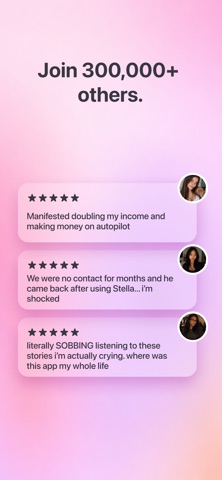


Images are served directly by the App Store / the product's own site (not rehosted here) — Stella
How it was built
- Build the audience before the product — become a creator trusted on a specific theme, as she did over years from a viral tarot video to 4.5M+ followers across TikTok, Instagram and YouTube
- Harvest years of DMs and comments asking for a tool to run her method daily, and treat that as the product requirement — demand already validated
- Vibe code with AI (Claude Code, Cursor) without knowing how to program, shipping in about a week what once took an engineering team months
- Put speed first — productize an idea and land it while the audience's enthusiasm is still hot
- Translate the format you understand most deeply from your own content directly into the product's core UX (personalized audio spoken from the perspective of your future self who already achieved it)
- Time to first release
- 7 days
- What AI did
- The founder openly says she can't code and built it through vibe coding with Claude Code and Cursor — AI drove productization cost near zero while the moat stayed on the distribution side
How it got users
- Generate the initial spike simply by showing yourself using it on existing channels (TikTok, Instagram, YouTube shorts) — zero ad spend
- Because the audience is already pre-sold on her view of manifestation, the awareness-interest-consideration stages collapse entirely and day one converts straight to purchase
- Prioritize owning a high-conversion front door over optimizing ARPU — the same price and the same product start completely differently depending on who receives it first
- Monetize by subscription and let a pre-warmed audience's conversion rate carry the first month (roughly $275-300K MRR and 12,000 paying subscribers within about two months of launch)
- Be honest about the limits of replication — what worked was 4.5M followers accumulated over years of posting; AI only lowered the cost of productization, and distribution remains the scarcest resource
- First users
- The existing following of 4.5M+ across TikTok, Instagram and YouTube, warmed over several years
- Early ad spend
- $0 — simply showing herself using it on her existing channels
The repeatable playbook
- 1Build the audience before the product — become a trusted creator in a niche (she spent years reaching 4.5M)
- 2Harvest the ‘I want this’ piled up in your audience’s DMs/comments as a product spec (validated demand)
- 3Even if you can’t code, ship a ~one-week MVP with AI (Claude Code / Cursor) — prioritize speed above all
- 4Translate the content/practice you know best directly into the product’s core UX
- 5Show yourself using it on existing channels (TikTok / Instagram / YouTube shorts) for zero-ad-spend velocity
- 6Charge via subscription and ride the pre-warmed audience’s high conversion from month one (a high-converting front door beats ARPU optimization)
The hard parts
The biggest trap here is over-generalizing. What worked wasn’t AI or a novel idea but the asset of a 4.5M audience built over years of posting; without it, the same steps won’t produce launch velocity. AI only lowered the cost of productizing — distribution remains the scarcest resource. On top of that, Stella itself drew early complaints in reviews about the lack of a free trial and its (high) pricing: even with a warmed audience, ‘price-and-experience friction’ didn’t disappear.
Deep dive
【Deep dive】Stella’s essence isn’t ‘a manifesting app’ — it’s a textbook of the 2026-era winning pattern: ‘whoever holds distribution first bolts on the product with AI afterward.’ We break down not *what* was built, but *what she already held, in what order*.
The moat is neither tech nor idea — it’s a pre-warmed audience. Manifesting apps aren’t new. Stella’s hard-to-copy moat is the 4.5M trusted followers she built over years. A normal indie build has to construct the ‘awareness → interest → consideration → purchase’ funnel from scratch after launch. But Sarah’s audience is already ‘pre-sold’ on her view of manifesting, so when she says ‘I made this,’ the entire top of the funnel is skipped and it converts to purchase from day one. The lesson: reverse the order — *become a trusted creator in a niche before you build the app*.
The pain point existed as validated demand inside the audience. She didn’t brainstorm an idea in a vacuum. Years of DMs and comments had accumulated the request: ‘I want a tool that runs *your* method every day.’ Stella simply productized demand she could already hear. The hardest part of market research — ‘will anyone actually pay?’ — was solved before launch. That’s the fork away from the classic failure of building before validating and burning cash.
AI erases the technical barrier; speed becomes the edge. A ‘creator who can’t code’ could ship a product because of vibe coding with Claude Code and Cursor. What once took an engineering team months, she says she shaped in ‘about a week.’ What matters here isn’t coding skill but speed — the ability to turn an idea into a product and drop it on the audience *before the heat fades*. Her ‘speed is everything’ stance is the most rational strategy for anyone who owns distribution.
The product UX is a direct translation of her ‘content format.’ Stella’s core experience (personalized audio from the ‘future self who already made it’ perspective) is the manifesting ‘format’ she honed in content for years, dropped into an app UX. She didn’t invent a novel experience from scratch — she translated a format her audience already valued into a product, so how it lands is predictable. The takeaway for builders: put the content/practice you understand most deeply at the very core of the product.
Monetization: a warmed audience converts on another level. Stella is subscription-based. Its price is reported inconsistently ($7/week, $40/month, $5.99–$19.99 tiers), and early on there were complaints about the lack of a free trial (i.e., pricing is contested). Even so, it reached $275K MRR a bit over a month post-launch because a pre-warmed audience converts incomparably better than cold ad traffic. Same price, same product — *who you distribute to first* changes launch velocity completely. Holding a high-conversion front door mattered more than optimizing ARPU up front.
An honest limit on repeatability (beware over-generalizing). This is not a ‘anyone who ships an AI app will win’ story. What worked was the 4.5M-audience asset, built over years of posting. AI only pushed the *cost of productizing* toward zero; *distribution* remains the scarcest resource. So the correct lesson isn’t ‘just build an app with AI’ — it’s ‘first build a trusted audience in a niche; AI will handle productizing in an instant later.’ The order itself is the core to reproduce.
Cross-case “growth playbook” report (coming soon)
We're building a paid report that aggregates every case in this database: which acquisition tactics worked, in which categories, and how well — insights you can't see from a single story. Get notified first when it launches.
Related cases
- Health & FitnessCal AI
Built in High School at 17 — How Cal AI’s “Just Snap Your Food” Calorie Tracker Hit ~$50M ARR in 18 Months and Sold to MyFitnessPal
A photo calorie tracker built by Zach Yadegari and a teenage founding team: snap your meal and AI estimates the calories. Bootstrapped to ~$50M ARR and 15M downloads in 18 months, it was acquired by MyFitnessPal in 2025.
18 monthsMonthly (est.)$4.2M/moTikTokShort-form videoInfluencer marketingInstagram - Health & FitnessPushscroll
Validated With a Fake Demo Before Writing Code — How Pushscroll’s ‘Do Push-ups to Unlock Social Media’ App Hit $30K/Month and 300K Downloads in 4 Months
A ‘replace doomscrolling with fitness’ app by Mario Ortiz Manero and Alejandro Sanchez: before you can open social media you must do a short workout (one push-up = one minute). The pair validated demand by posting a fake demo of an app that didn’t exist yet, then built it — reaching $30K/month and ~300K downloads in about four months on organic short-form alone.
4 monthsMonthly (est.)$30k/moTikTokShort-form videoInstagramYouTube - Health & Fitness3AK
Zero Code, Two Track Athletes — How 3AK Was Built in Rork Without Writing a Line, Turning a 150K Following into $10K in Month One and ~$17K MRR (RevenueCat-Verified) in Two Months
3AK is a track & field training app that active D1 athletes Braylin Byrd and Christian Rac built with the no-code tool Rork. Starting from their own 150K following and zero ad spend, it hit $10K in month one and ~$17K MRR (RevenueCat-verified) within about two months.
2 monthsMonthly (est.)$17k/moInstagramTikTokShort-form videoInfluencer marketing