Zero Code, Two Track Athletes — How 3AK Was Built in Rork Without Writing a Line, Turning a 150K Following into $10K in Month One and ~$17K MRR (RevenueCat-Verified) in Two Months
3AK is a track & field training app that active D1 athletes Braylin Byrd and Christian Rac built with the no-code tool Rork. Starting from their own 150K following and zero ad spend, it hit $10K in month one and ~$17K MRR (RevenueCat-verified) within about two months.
- Monthly (est.)
- $17k/mo
- Time to grow
- 2 months
- Users
- 40K
- Launched
- 2026
Key takeaways
- Before building, grow a distribution network (social following) where trust concentrates on you in a specific niche
- Pull demand from DMs/comments, not surveys — turn the saturated ‘teach me’ requests into the product
- As a non-engineer, ship a native app in days with no-code (e.g. Rork) and take payments from month one
The pain point, and how they found it
For track athletes and serious runners, training is a mess of disconnected tools: a stopwatch, a notes app, video review, a calorie counter, a coach’s program — all separate, and none built specifically for track. Braylin and Christian didn’t discover this pain through research. The DMs flooding their social accounts every day — ‘what’s your training?’, ‘send me your program’ — were the demand itself. The pain point wasn’t something to find; it was already piling up in their inbox.
Background & product
3AK (Three Athletic Kings) is an all-in-one mobile app built specifically for track & field training. It bundles AI-powered stride (form) analysis, athlete-focused calorie and nutrition tracking, custom workout programs, daily challenges, GPS run tracking, and an in-app AI coach into one place. The core idea is collapsing a scatter of generic training tools into something made for track.
It was built by Braylin Byrd (Texas Tech) and Christian Rac (Texas Southern), two active D1 track athletes at schools eight hours apart. By the time they were 18, the pair had failed at roughly five businesses — dropshipping, day trading, cutting hair. The one thing that compounded through all of it was a social following built on real track-training content: 112K Instagram followers on Braylin’s account, 42.5K on Christian’s. Together, 150K+ people became a distribution network they could fire up for free.
In January 2026 they built and launched the app in Rork, an AI no-code app builder, without writing a single line of code. Rork turns text descriptions into native iOS/Android apps, letting non-engineers ship in days. 3AK was born from that ‘translate, don’t build’ approach.
The result came fast. $10K in revenue in the first month, then ~$17K MRR within about two months ($17,460 in the last 28 days, verified by RevenueCat), for $45K+ cumulative in two months. Around 40K users, a 4.7 App Store rating — and not a cent spent on paid ads. They cut the price from $59.99/year to $29.99/year so high-school and college athletes could actually afford it, lifting conversion. On top of that, a Shopify store selling training programs adds another $100–200 a day.
Pricing
Free download. In-app purchases run $6.99–$9.99/week, $9.99/month and $29.99–$49.99/year (per App Store; several prices appear for the same period, so it looks like paywall A/B testing).
App screens

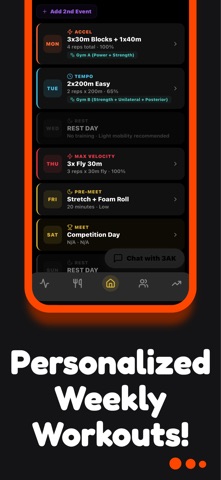


Images are served directly by the App Store / the product's own site (not rehosted here) — 3AK
How it was built
- Grow the distribution network first, in a niche where you already command trust — real track training content built 112K plus 42.5K Instagram followers, over 150K combined
- Source demand from DMs and comments rather than research — the saturated 'give me a program' requests became the product directly
- Build a native app without writing a line of code using Rork, a no-code AI app builder, while remaining non-engineers
- Bundle scattered training tools specifically for track — AI form analysis, athlete nutrition tracking, custom workouts, daily challenges, GPS runs and an AI coach in one place
- Price on conversion rather than ARPU — drop from $59.99/year to $29.99/year so high school and college athletes can actually pay
- What AI did
- Rork, a no-code AI builder, handled implementation entirely — neither founder is an engineer — while AI form analysis and an AI coach carry the product value
How it got users
- Use no paid advertising at all and sell only into the owned distribution network of 150K+ followers
- Sell only into the market you actually live in — being genuine D1 athletes is trust an outsider cannot buy
- Create a state where people pay simply because 'that athlete made it', proving insider status through the resolution of the form, programming and nutrition advice
- Collect twice from the same audience — the app subscription plus training programs sold on Shopify adding $100-200 a day
- Because organic is the main engine, revenue keeps stacking even during periods when marketing stopped entirely ($45K over two months)
- First users
- The owned social following of 150K+ grown earlier on track training content
- Early ad spend
- $0 — no paid advertising whatsoever
The repeatable playbook
- 1Before building, grow a distribution network (social following) where trust concentrates on you in a specific niche
- 2Pull demand from DMs/comments, not surveys — turn the saturated ‘teach me’ requests into the product
- 3As a non-engineer, ship a native app in days with no-code (e.g. Rork) and take payments from month one
- 4Sell only into a market you personally belong to — insider trust you can’t fake becomes your biggest ad
- 5Price by conversion, not ARPU — meet your buyers at a price they can afford to maximize user count
- 6Monetize the same audience twice: a subscription (recurring) plus one-off program sales (Shopify, immediate cash)
The hard parts
Behind the fast start, Braylin and Christian had failed at roughly five businesses — dropshipping, day trading, cutting hair — before they turned 18. 3AK was fast not because of talent or luck, but because the asset they quietly compounded through those failing years — a social following built on track content — became the launchpad. The distribution network they’d stacked up only became live ammunition on the sixth attempt.
Deep dive
【Deep dive】The essence of 3AK is the inverse of ‘build the app, then find customers.’ It’s audience-first, product-second. Let’s unpack the order.
Don’t hunt for demand — read your inbox. Most indie developers start from ‘what should I build’ and then struggle to acquire users afterward. Braylin and Christian did the reverse: they grew a social following on track-training content first, and only once the ‘send me your program’ DMs had saturated did they turn those exact requests into an app. That’s not market research — it’s collecting on demand that was already validated. The $10K in month one wasn’t luck so much as cashing in an inbox that had accumulated years of demand. The implication for indie builders is blunt: before the idea, what decides the game is whether you own a place where trust concentrates on you within a specific niche — a distribution network.
No-code removes the ‘I can’t build’ excuse. Neither founder is an engineer. They still shipped a native app in Rork without a single line of code and took payments from month one. The lesson: technical skill is no longer the barrier to entry. A product’s moat has shifted from implementation difficulty to (1) whose pain you solve and (2) how specifically you solve it. 3AK’s moat is its track-specific bundled UX and the credibility of makers who are themselves competitors — not the code. Non-engineers especially should read this as live proof that ‘you can too.’
Sell only into a market you belong to (trust you can’t fake). 3AK lands because the makers are real D1 athletes. How to read your form, how to structure training, how to think about nutrition — these are built with a resolution only someone who actually runs track can produce. So even without ads, followers pay simply because ‘that athlete built it.’ A developer parachuting into someone else’s niche can’t buy that insider standing. Choosing a market you already live in is itself your biggest marketing asset.
Price by conversion, not by ceiling. They dropped the price from $59.99/year to $29.99/year. That halves ARPU, but when your buyers are high-school and college athletes with little disposable income, meeting them at an affordable price grows total revenue. Lower price lifted conversion, which grew users, who in turn generated more word of mouth on social. Designing price around ‘how many can pay’ rather than ‘how much per person’ is what drove the speed of scale.
Monetize the same audience twice (app × commerce). Revenue isn’t just the app subscription. To the same 150K audience, they also sell training programs via a Shopify store, adding a separate $100–200/day. From one distribution network they collect two layers — a monthly subscription (recurring) and one-off program sales (immediate cash). The power of owning an audience is exactly this: you can sell to the same customers in multiple ways. Indie builders should think beyond a single app and stack products on top of an audience asset.
Growing with zero ads means it doesn’t stop when you stop. What’s striking is that they got here without any paid advertising — in fact they report adding $45K (cumulative over two months) even during a period when they completely paused marketing. When organic content is the primary acquisition engine, you don’t depend on ad spend as a variable cost, so margins are high and the risk of grinding to a halt when cash runs low is small. Low build cost via no-code plus zero ad spend is why it runs profitably from month one — a textbook example of the ‘bootstrapped, independent developer’ thesis this database is built around.
Cross-case “growth playbook” report (coming soon)
We're building a paid report that aggregates every case in this database: which acquisition tactics worked, in which categories, and how well — insights you can't see from a single story. Get notified first when it launches.
Related cases
- Health & FitnessCal AI
Built in High School at 17 — How Cal AI’s “Just Snap Your Food” Calorie Tracker Hit ~$50M ARR in 18 Months and Sold to MyFitnessPal
A photo calorie tracker built by Zach Yadegari and a teenage founding team: snap your meal and AI estimates the calories. Bootstrapped to ~$50M ARR and 15M downloads in 18 months, it was acquired by MyFitnessPal in 2025.
18 monthsMonthly (est.)$4.2M/moTikTokShort-form videoInfluencer marketingInstagram - Health & FitnessStella
Audience First, Product Second — How a 4.5M-Follower Creator Used AI (Without Writing a Line of Code) to Take Manifesting App Stella to ~$300K MRR in About Two Months
Immigrant creator Sarah Perl (@hothighpriestess) built Stella with AI (Claude Code / Cursor) despite not being able to code, on top of the 4.5M-follower manifesting audience she’d spent years building. It hit ~$275K–$300K MRR and 12,000 paying subscribers in about two months — a textbook ‘distribution-first’ case.
2 monthsMonthly (est.)$275k/moTikTokInstagramShort-form videoInfluencer marketing - Career & JobsSprout
Sprout, the “Tinder for jobs” built by a non-engineer in college — betting on distribution over building to reach $250K MRR in 8 months
A job-search app built by Nicole Cheung while at Claremont McKenna: swipe to apply, AI tailors a resume and cover letter per role, and an agent auto-submits on the employer’s site. With no ads and no VC it hit $250K MRR in 8 months — reusing the same creator-army playbook behind her earlier beauty app Glam Up (1M users in 6 months).
8 monthsMonthly (est.)$250k/moTikTokInstagramYouTubeShort-form video