Validated With a Fake Demo Before Writing Code — How Pushscroll’s ‘Do Push-ups to Unlock Social Media’ App Hit $30K/Month and 300K Downloads in 4 Months
A ‘replace doomscrolling with fitness’ app by Mario Ortiz Manero and Alejandro Sanchez: before you can open social media you must do a short workout (one push-up = one minute). The pair validated demand by posting a fake demo of an app that didn’t exist yet, then built it — reaching $30K/month and ~300K downloads in about four months on organic short-form alone.
- Monthly (est.)
- $30k/mo
- Time to grow
- 4 months
- Users
- 300K
- Launched
- 2025
Key takeaways
- Before writing code, make a ‘fake demo’ video of an app that doesn’t exist yet and validate demand by the reaction (your first MVP is content, not code)
- Use the viral clip as the blueprint — translate the highest-reacting framing directly into the product’s core experience
- Don’t avoid the red ocean (screen-time management); split it with one angle only: unlock by exercise, not prohibition
The pain point, and how they found it
‘I want to stop endless scrolling but can’t’ is a near-universal pain. Screen-time blockers are everywhere, but most just make apps harder to open — pure friction you eventually override. Pushscroll attacked the same pain from a different angle: instead of forbidding the app, it makes you do a set of exercise first, transferring the dopamine of social media onto physical movement. Flipping the design from ‘quit this’ to ‘get a little healthier every time you open it’ was the entry point.
Background & product
Pushscroll is a screen-time app that makes you do a short workout (push-ups, squats, planks, etc.) before you can open social media. It uses the phone camera and pose detection to count reps, so you ‘buy’ app time with exercise — roughly one push-up for one minute. It isn’t just a blocker; the core is redirecting the doomscroll impulse into movement.
It was built by two people — Mario Ortiz Manero and Alejandro Sanchez (Pushscroll GmbH, Switzerland, founded 2025, bootstrapped). Mario is a former Lyft backend engineer, also known in the Rust world for open-source work (the Spotify client ‘rspotify,’ among others). No splashy funding, no giant pre-built audience — a classic ‘have-nots’ start.
The biggest lesson here is less about the product than the order of operations. Before writing any code, they made a ‘fake demo’ video of an app that didn’t exist yet and posted it. That single clip pulled ~80K views, and the comments filled with ‘please build this’ and ‘where can I download it?’ Only after demand was proven did they build the real thing — the idea that ‘your first MVP isn’t code, it’s content.’
Post-launch growth stayed consistently organic short-form. Because ‘work out, then the app unlocks’ is a before/after you can grasp in a second, one video doubles as both ad and demo. With this formula, roughly four months after building the app they reached ~$30K/month, ~300K cumulative downloads, and ~4,000 paying users — cracking the ‘red ocean’ of screen-time management with a single sharp angle (unlock by exercise) and the discipline of proving demand before building.
Pricing
Free download. In-app purchases are $14.99/month and $24.99–$59.99/year, plus items with no billing period shown at $8.99–$29.99 (per App Store; several prices appear for the same period, so it looks like paywall A/B testing).
App screens
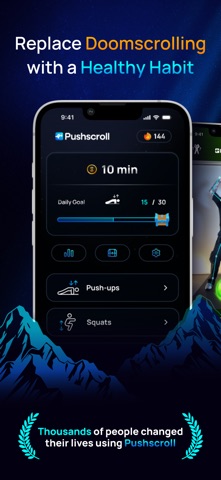


Images are served directly by the App Store / the product's own site (not rehosted here) — Pushscroll
How it was built
- Before writing a single line of code, produce a fake demo video of an app that doesn't exist and post it to social media — the first MVP is content, not code
- Read the result as a live demand test: that one video drew about 80,000 views and a comment section full of 'build this' and 'where can I download it?', so a weak response would simply mean dropping the idea at near-zero cost
- Use the video that hit as the blueprint — translate the angle people responded to most (the before/after of the app refusing to open until you exercise) straight into the core experience
- Don't avoid the red ocean of screen-time management; split it with exactly one angle — unlock through exercise rather than blocking
- Detect poses through the phone camera to count reps, so time is bought with movement — one push-up buys one minute of app time
How it got users
- Pick subject matter whose before/after reads in seconds, so a single video works as ad, demo and word-of-mouth seed at once — the absurdity of having to do push-ups before you can scroll is inherently shareable
- Skip paid advertising and run short-form across several platforms at volume to increase the number of hits
- Amplify whatever grows, playing the standard volume-then-amplify game with cheap-to-produce videos
- Favor adoption over ARPU and stack profitably with a tiny bootstrapped team and low fixed costs (about 4,000 paying users at roughly $30K/month)
- First users
- The people who filled the comment section of the fake demo video (about 80,000 views) posted before the app existed
- Early ad spend
- $0 — no paid advertising, only organic short-form across several platforms
The repeatable playbook
- 1Before writing code, make a ‘fake demo’ video of an app that doesn’t exist yet and validate demand by the reaction (your first MVP is content, not code)
- 2Use the viral clip as the blueprint — translate the highest-reacting framing directly into the product’s core experience
- 3Don’t avoid the red ocean (screen-time management); split it with one angle only: unlock by exercise, not prohibition
- 4Pick a subject whose before/after reads in seconds so one video serves as ad, demo, and word-of-mouth seed at once
- 5Skip paid ads; run high volumes of short-form across platforms to increase the number of ‘hits,’ then amplify what pops
- 6Prioritize adoption over price and compound profitably with a tiny, bootstrapped, low-fixed-cost setup
The hard parts
The headline $30K/month sits on an organic short-form engine that stalls when you stop feeding it: cut the volume and views and downloads thin out, and screen-time management — being a red ocean — is quickly copied. The heart of reproducing this is the nerve to validate with a fake demo: you must be willing to kill weakly-reacting ideas and bend the product, without compromise, toward what hit; slip back to ‘just build it’ without proving demand and you sink in the same ocean. The friction of pose detection (space, lighting, hassle) also churns some users — the familiar retention risk of health apps.
Deep dive
【Deep dive】The essence of Pushscroll isn’t the ‘unlock by push-ups’ feature — it’s the order of operations: proving it would sell before building it. Here’s how a two-person team minimized risk on the way to $30K/month.
Your first MVP isn’t code, it’s content. Most indie builders burn out on the ‘build first, struggle for distribution later’ path. Pushscroll inverted it. Before writing a line of code they produced a ‘fake demo’ video of an app that didn’t exist and posted it. That one clip pulled ~80K views, with comments flooded by ‘build this’ and ‘where can I buy it?’ It’s a free, live demand test: if the reaction is weak you drop the idea, cutting to near-zero the risk of sinking months into building. The key is refusing to leave ‘will it land?’ to chance — you settle it before development.
Use the viral clip as the blueprint. A winning fake demo means two things. First, proof of demand. Second, discovery of the winning creative — which framing lands. They translated the highest-reacting angle (the app won’t open until you exercise) directly into the product’s core experience. The ‘winning angle’ found in content simultaneously specifies both the feature spec and the marketing. Because the pitch is set before the build, it lands from day one instead of hunting for a hook after shipping.
Don’t avoid the red ocean — split it with one angle. Screen-time management is crowded. Rather than chasing a new category, they entered a market whose demand was already proven, with exactly one differentiator: unlock by exercise, not prohibition. A red ocean is also evidence of demand. The contest shifts from novelty of market to sharpness of angle on the same pain. Amid a sea of ‘make yourself quit’ apps, flipping to ‘get healthier every time you open it’ created freshness inside the familiar.
Product = content, to cut distribution cost. The hardest part of social distribution is whether a thing reads on screen. Pushscroll’s before/after (you want to scroll — but first, push-ups) reads in seconds, and it’s funny enough that people want to show others. So one video is ad, demo, and word-of-mouth seed at once. They leaned on this fit to run high volumes of low-cost short-form across platforms without paid ads, then amplified whatever popped — the classic volume-times-amplification play.
Adoption over price; the discipline of bootstrapping. ~4,000 paying users at a ~$30K/month scale. Rather than jacking up price, they chose an adoption model, since ‘work out and get healthier’ pairs well with word of mouth and UGC. No outside funding is disclosed; a tiny two-person setup keeps fixed costs low while staying profitable. Not a splashy ARR proclamation but the most reproducible path for a have-not indie: validate, then build; concentrate on the framing that hit; keep the loop small.
A caution on reproducing this. The heart of the playbook is the nerve to validate with a fake demo — being willing to kill ideas that don’t react, and to bend the feature set, without compromise, toward the framing that did. The moment you slip back to ‘let’s just build it’ without proving demand, the red ocean swallows you. The order itself is the moat.
Cross-case “growth playbook” report (coming soon)
We're building a paid report that aggregates every case in this database: which acquisition tactics worked, in which categories, and how well — insights you can't see from a single story. Get notified first when it launches.
Related cases
- Health & FitnessStella
Audience First, Product Second — How a 4.5M-Follower Creator Used AI (Without Writing a Line of Code) to Take Manifesting App Stella to ~$300K MRR in About Two Months
Immigrant creator Sarah Perl (@hothighpriestess) built Stella with AI (Claude Code / Cursor) despite not being able to code, on top of the 4.5M-follower manifesting audience she’d spent years building. It hit ~$275K–$300K MRR and 12,000 paying subscribers in about two months — a textbook ‘distribution-first’ case.
2 monthsMonthly (est.)$275k/moTikTokInstagramShort-form videoInfluencer marketing - Health & FitnessCal AI
Built in High School at 17 — How Cal AI’s “Just Snap Your Food” Calorie Tracker Hit ~$50M ARR in 18 Months and Sold to MyFitnessPal
A photo calorie tracker built by Zach Yadegari and a teenage founding team: snap your meal and AI estimates the calories. Bootstrapped to ~$50M ARR and 15M downloads in 18 months, it was acquired by MyFitnessPal in 2025.
18 monthsMonthly (est.)$4.2M/moTikTokShort-form videoInfluencer marketingInstagram - Health & Fitness3AK
Zero Code, Two Track Athletes — How 3AK Was Built in Rork Without Writing a Line, Turning a 150K Following into $10K in Month One and ~$17K MRR (RevenueCat-Verified) in Two Months
3AK is a track & field training app that active D1 athletes Braylin Byrd and Christian Rac built with the no-code tool Rork. Starting from their own 150K following and zero ad spend, it hit $10K in month one and ~$17K MRR (RevenueCat-verified) within about two months.
2 monthsMonthly (est.)$17k/moInstagramTikTokShort-form videoInfluencer marketing