A Travel Creator × a Stanford Dev — How TripBFF Solved Solo-Travel Loneliness and Reached 1M+ Downloads and $1M+ ARR (~$83K/mo) With Zero Ad Spend and 30+ UGC Accounts
TripBFF turns solo-travel loneliness into a social app for finding travel friends. Founded in 2023 by travel-content creator Isabella Comellini (CMO) and Stanford CS grad Ethan Brimhall (CEO), it bootstrapped — with zero paid ads — to a founder-stated 1M+ downloads and $1M+ ARR (~$83K/mo) by running a ‘distribution factory’ of 30+ UGC accounts posting ~3x/day.
- Monthly (est.)
- $83k/mo
- Users
- 1.0M
- Launched
- 2023
 Isabella@isabellacomelli
Key takeaways
- A social app’s real enemy is the ‘empty room,’ not a competitor — before building, design how to get the first users in at scale and cheaply (revenue is the result; the battle is upstream)
- Make acquisition an always-on factory, not a one-hit lottery (30+ UGC accounts × ~3 posts/day to maximize at-bats, then replicate winners across every account)
- Make the product itself the content (pick a visualizable pain point — lonely trip → travel friends — so each video is both ad and demo)
The pain point, and how they found it
Solo travel is freeing, but many people hit a wall of loneliness — spending days abroad without really talking to anyone. For a generation whose social lives were cut off during COVID, that pain was acute. TripBFF’s co-founder Isabella, while posting travel content, was flooded with DMs and comments asking ‘how do you actually make friends while traveling?’ — the pain point wasn’t found through market research, it was already sitting in her audience’s replies. Existing social and dating apps weren’t optimized for the concrete job of ‘find a travel companion by destination and dates.’
Background & product
TripBFF matches solo travelers by destination, dates, and interests so they can find friends to spend time with on the ground. You build a profile, add your travel plans, and connect with travelers who’ll be in the same city at the same time — essentially ‘a social network for travel companions.’
It was built by two co-founders. Isabella Comellini (CMO) is a travel-content creator — the ‘non-technical, distribution-side’ founder who owns growth and brand. Ethan Brimhall (CEO) is an iOS developer with a computer-science degree from Stanford — the ‘technical’ founder who builds the product. They launched in June 2023 and run the company bootstrapped, with no outside capital.
What makes this case interesting is less the revenue (a founder-stated ~$83K/month, $1M+ ARR) than the single question of ‘how do you fill a social app that starts out empty?’ Social and matching products always face the cold-start problem: right after launch nobody is there, so the value is zero. Most apps die there. TripBFF broke through not with paid ads but with an in-house content factory.
Specifically, in 2025 alone they spun up 30+ UGC-style video accounts and posted on Instagram Reels and TikTok at roughly 3 videos per account per day. They reached ~475M cumulative views (Isabella posted in May 2025 that Instagram alone was ‘near half a billion views’) and grew to 1M+ downloads without spending essentially a single dollar on ads. The ‘lonely trip → travel friends’ story is inherently visual and tellable, and every video doubles as a product demo. Acquisition and the product experience overlap inside the same content — that’s the heart of this case.
Pricing
Free download. In-app purchases run $6.99–$14.99/week, $4.99–$19.99/month, $24.99/3 months and $29.99–$79.99/year (per App Store; several prices appear for the same period, so it looks like paywall A/B testing).
App screens
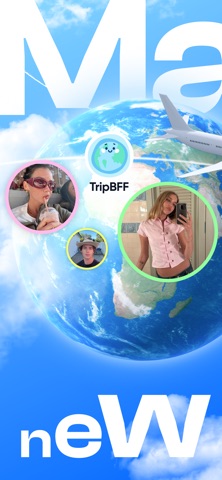

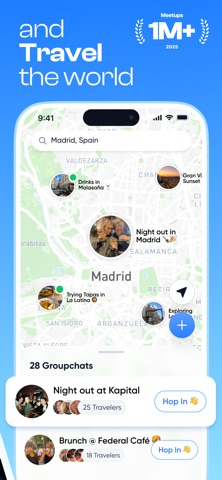

Images are served directly by the App Store / the product's own site (not rehosted here) — TripBFF
From the founder (primary source)

tripbff insta at almost half a billion views so insane🤯🤯


Welcome to TripBFF, a social travel app I co-founded 12 months ago. - 700k downloads since launch (iOS only) - 600k followers on IG organically - $0 spent on customer acquisition / development Ask me anything ✈️
How it was built
- Take the pain point from your own audience rather than market research — as a travel content creator, the demand to make friends while traveling had been arriving in follower DMs and comments long before the app
- Pair a non-technical distribution founder with a technical one so neither half is missing — a travel content writer as CMO and a Stanford CS iOS developer as CEO
- Keep the scope to a social network for travel companions: build a profile, register your trip, connect with travelers in the same city at the same time
- Layer revenue thinly on top of zero-cost acquisition through freemium social plus a TripBFF Pro subscription ($4.99/week, $9.99/month, $79.99/year)
- Never defer the security design for sensitive data like location — a security researcher disclosed that user locations were exposed with excessive precision
How it got users
- Recognize that a social app's real enemy is the cold-start emptiness problem, not competitors — travel-companion matching is two-sided and starts at zero value the moment it launches
- Make acquisition a factory that runs continuously rather than a wait for one viral hit — over 30 UGC video accounts launched in 2025 alone
- Post about three videos a day per account on Instagram Reels and TikTok, buying algorithm lottery tickets through sheer volume
- Roll winning formats out to every account, with redundancy so a shadowban or a stall on one account never stops the whole machine
- Choose a before/after subject — the loneliness of solo travel giving way to good times with friends found on the road — so each video is both the ad and the demo
- Stack roughly 475M cumulative views and over 1M downloads without spending virtually a single dollar on advertising
- Early ad spend
- Effectively $0 — only an in-house content factory of 30+ UGC accounts
The repeatable playbook
- 1A social app’s real enemy is the ‘empty room,’ not a competitor — before building, design how to get the first users in at scale and cheaply (revenue is the result; the battle is upstream)
- 2Make acquisition an always-on factory, not a one-hit lottery (30+ UGC accounts × ~3 posts/day to maximize at-bats, then replicate winners across every account)
- 3Make the product itself the content (pick a visualizable pain point — lonely trip → travel friends — so each video is both ad and demo)
- 4Source the pain point from your audience, not market research (validate demand in followers’ DMs/comments before founding)
- 5Pair non-technical (distribution/content) × technical (build) to fill the classic indie half-engine (can’t sell / can’t build)
- 6Stay bootstrapped with zero paid ads; layer a freemium-social + subscription (Pro) thinly on top to monetize
- 7Don’t defer the safety design of location and sensitive data even amid fast growth (trust is lost in one blow)
The hard parts
As a social app handling location, it was the subject of a disclosed vulnerability — security researcher Jonathan Leitschuh reported that TripBFF exposed users’ location data far too precisely. Racing ahead on ‘factory-style’ acquisition while deferring the safety design of location and personal data can cost trust in a single blow. As for reproducibility limits: the moat is Isabella’s day-job skill of *producing travel content* plus the operational stamina to run 30+ accounts every day — hard to copy directly for anyone who can’t manufacture content at that cadence.
Deep dive
【Deep dive】The real lesson of TripBFF isn’t that it ‘went viral’ — it’s that it solved the cold-start problem of the single hardest category to launch, a social app, with a system rather than capital. Let’s break it down.
The enemy isn’t a competitor, it’s the ‘empty room’ problem. Single-player apps like calorie trackers or image generators create value for one user alone. But travel-friend matching is a two-sided product that only works when *other* travelers are present — right after launch there’s no one, so value starts at zero. This is where most apps stall, unable to gather supply (travelers) and demand (travelers) at once. Every TripBFF move targets this one thing: how to get the first users in — at scale and cheaply. The revenue (a founder-stated $1M+ ARR, ~$83K/mo) is the result; the real battle was upstream of it.
Founder-market fit: the pain point was already inside her audience. Before building anything, Isabella was a travel-content creator already bombarded by DMs and comments asking ‘how do you make friends while traveling?’ She had solved market research’s hardest question — is there real, hurting demand? — with her own audience, pre-founding. And her core skill *is* gathering people with video. So the app began with a structure where its biggest barrier — distribution — could be hit directly with the founding team’s day-job skill.
Turn acquisition into an always-on factory, not a one-hit lottery. Most indie builders chase the single video that pops. TripBFF did the opposite: run 30+ accounts, each shipping ~3 videos a day, by design a game of volume. The point is threefold — (1) buy many algorithmic lottery tickets so ‘one of them lands’ becomes a function of volume rather than luck, (2) replicate any winning format across all accounts, and (3) build redundancy so one account getting shadow-banned or stalling doesn’t stop the whole engine. The ~475M views and ~40K monthly downloads came from factory utilization, not one genius clip.
Product = content: each video is both the ad and the demo. The before/after of ‘lonely solo trip → good times with friends found on the road’ is inherently cinematic, tellable, and self-relevant to viewers. So a TripBFF video is simultaneously an ad for the app and a demonstration of the app’s value itself. When acquisition content and product experience overlap in the same material, the distance from watch → install → first value collapses. The choice of subject (a highly visualizable pain point) directly determines acquisition efficiency.
A complementary non-technical × technical pair, and monetization. The setup pairs a distribution talent (Isabella/CMO) with a builder (Ethan/CEO, Stanford CS). It fills the classic indie failure of ‘can build but can’t sell / can sell but can’t build’ with two people. Revenue is freemium social plus a subscription, ‘TripBFF Pro’ ($4.99/wk, $9.99/mo, $79.99/yr), layered thinly on top of zero-ad-spend acquisition. Bootstrapped with no outside funding, it runs at a founder-stated $1M+ ARR (~$83K/mo); more conservative secondary reports put it at $50–60K MRR.
The shadow lesson: rapid growth and ‘sensitive-data safety’ are separate problems. The flip side surfaced too: as a social app handling location, its risk was real. Security researcher Jonathan Leitschuh disclosed a vulnerability in which TripBFF exposed users’ location data far too precisely. Even when acquisition races ahead through ‘factory’ tactics, deferring the safety design of location and personal data can destroy the foundation of trust in a single blow — a warning anyone reproducing this should bake into the design from day one.
Cross-case “growth playbook” report (coming soon)
We're building a paid report that aggregates every case in this database: which acquisition tactics worked, in which categories, and how well — insights you can't see from a single story. Get notified first when it launches.
Related cases
- Socialnomadtable
Built Solo by an Ex-Amazon Engineer — How nomadtable Turned Solo-Travel Loneliness Into 2M Users and $2M ARR in Two Years
A meetup app for solo travelers built single-handedly by Jay Raavi: it matches you with nearby travelers in real time so you can meet up through activities and group chats. Fully bootstrapped (no team, no VC), it hit 1M downloads and $65K/month in under a year, then grew to 2M users and $2M ARR about two years after founding.
24 monthsMonthly (est.)$167k/moShort-form videoTikTokInstagramInfluencer marketing - SocialSSocial Wizard
Arrived in the US with $100 — How a 22-Year-Old Built an App That Kills “Fear of the Wrong Reply” on GPT-4 Vision’s Launch Day and Hit $60K/Month
Kelechi Onyeama left Nigeria for the US with just $100 and built Social Wizard right as GPT-4 Vision launched: upload a screenshot of a chat and AI suggests what to say back. Daily TikTok posting snowballed into $60K/month and 500K+ downloads — and his second app, CleanEats, later got acquired too.
Monthly (est.)$60k/moTikTokInstagramShort-form videoInfluencer marketing - Health & FitnessCal AI
Built in High School at 17 — How Cal AI’s “Just Snap Your Food” Calorie Tracker Hit ~$50M ARR in 18 Months and Sold to MyFitnessPal
A photo calorie tracker built by Zach Yadegari and a teenage founding team: snap your meal and AI estimates the calories. Bootstrapped to ~$50M ARR and 15M downloads in 18 months, it was acquired by MyFitnessPal in 2025.
18 monthsMonthly (est.)$4.2M/moTikTokShort-form videoInfluencer marketingInstagram