Built by Three Teens in ~10 Days — How QUITTR, a “Quit Porn” Digital-Wellness App, Hit $250K MRR in 4 Months With Zero Outside Funding
A digital-wellness app that helps people quit pornography, built by three teens led by Alex Slater (19). Shipped in ~10 days with SwiftUI + Firebase + Superwall, it went from $37K in month one to $250K MRR in four months — bootstrapped, and grown via Reddit, TikTok, and meme ads.
- Monthly (est.)
- $250k/mo
- Time to grow
- 4 months
- Users
- 1.0M
- Launched
- 2024
 Alex Slater@aslater
Key takeaways
- Don’t manufacture demand — pick a niche already organized into a community (Reddit r/NoFap, self-improvement)
- Perfection is a trap: ship fastest with a days-to-build stack (SwiftUI + Firebase + Superwall) and confirm money changes hands
- Start with small out-of-pocket influencer spend, then reinvest earnings into acquisition (a self-funded loop)
The pain point, and how they found it
The pain was on the *supply* side. Millions of people wanting to quit porn already gathered in Reddit’s r/NoFap and self-improvement communities — yet all they had were free forums and crude counter apps; there was no polished consumer product with real gamification, design, and a paywall. QUITTR hit a niche where *demand was already aggregated into a community but no serious product existed*. And the more taboo the topic, the stronger the motive to pay for a private, anonymous app.
Background & product
QUITTR is a digital-wellness app for people who want to break the habit of watching pornography. It offers a streak counter for consecutive clean days, a ‘panic button’ for when an urge hits, a content blocker, a community, and behavioral-science-based recovery plans — framing addiction as ‘gamified self-improvement.’
It was built by three people: Alex Slater (19, CEO), Connor McLaren (22, marketing), and Chris (17). Alex, originally from the UK and later based in San Francisco, taught himself to code at 17. He assembled the product in roughly 10 days using SwiftUI + Firebase + Superwall, shipping it before polishing it — and that speed was the starting point.
They launched in 2024. The striking part is the capital structure: they stayed fully bootstrapped with no VC. In month one Connor put $3,000 of his own money into influencers, which generated $37,000 in revenue. From there they ran a self-funded loop — reinvesting earnings into acquisition — reaching $250K MRR by month four and 350K downloads across 120 countries with $1.1M+ cumulative revenue by month six.
The app kept climbing: ~$500K MRR and 1M+ downloads by month nine, and 2M+ users today. It’s a case of a teenage team using design and distribution to capture a niche that lacked a serious product precisely because the topic was too embarrassing.
Pricing
Free to download with in-app purchases: $9.99–$14.99 monthly, $19.99–$29.99 yearly, or a $49.99 lifetime unlock. The price spread reflects ongoing paywall A/B tests.
App screens


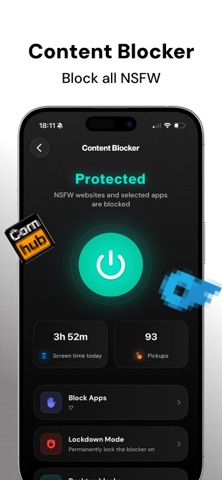
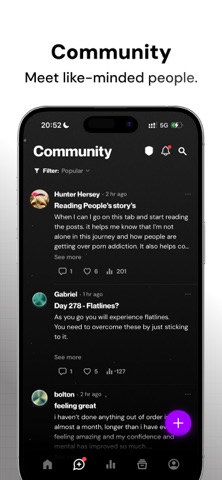
Images are served directly by the App Store / the product's own site (not rehosted here) — QUITTR
From the founder (primary source)


I see QUITTR as the first step in building a billion-dollar company focused on selling the apex of human health. Step one of taking a big share of a smaller, focused market is complete. Still a lot of work to do, e.g reaching $1-3M+ month which is more than possible. Only Show more
How it was built
- Pick a stack a solo dev can assemble in days (SwiftUI + Firebase + Superwall) to minimize time-to-validation
- Ship v1 in about 10 days without polishing (the founder later called perfecting the product 'the biggest founder trap')
- Assume ship-then-fix, and first confirm as fast as possible that money actually changes hands
- Continuously A/B onboarding and the paywall in Superwall to tune the purchase experience
- Time to first release
- 10 days
How it got users
- Don't manufacture demand — pick a niche already organized into a community (Reddit r/NoFap and self-improvement)
- In month one, spend $3,000 out of pocket on influencers and recoup $37,000
- Reinvest earnings straight back into acquisition, running a self-funded loop
- Mass-produce insider-voice native posts that don't look like ads on Reddit and TikTok (one TikTok hit 10M views and $100,000 in sales)
- Turn a heavily moderated category into an advantage — $100 on troll meme ads swapping 'porn' for the 🌽 emoji returned 10.8M impressions and $21,758
- First users
- People already gathered in Reddit's r/NoFap and self-improvement subreddits
- Early ad spend
- $3,000 out of pocket in month one on influencers, recouped $37,000 and reinvested
The repeatable playbook
- 1Don’t manufacture demand — pick a niche already organized into a community (Reddit r/NoFap, self-improvement)
- 2Perfection is a trap: ship fastest with a days-to-build stack (SwiftUI + Firebase + Superwall) and confirm money changes hands
- 3Start with small out-of-pocket influencer spend, then reinvest earnings into acquisition (a self-funded loop)
- 4Make distribution ‘doesn’t-look-like-an-ad,’ mimicking the audience’s vocabulary and tone (Reddit × TikTok)
- 5Turn a regulated topic to your advantage — troll-style meme ads ($100 → $21,758, 🌽 to dodge filters)
- 6A/B onboarding and the paywall with Superwall, engineering a checkout that accounts for shame and anonymity
The hard parts
The sensitive category brings constant headwinds: major ad platforms scrutinize anything ‘porn’-related, so conventional performance ads rarely pass. QUITTR routed around this via the 🌽 (corn = a euphemism for ‘porn’) emoji and meme inventory, but the structural risk of policy changes and account bans remains. And the founder himself admits ‘perfecting the product is the biggest trap’ — the early build was rough and only worked on a ‘ship then fix’ basis.
The heaviest lesson, however, is about handling sensitive data. In March 2026, 404 Media reported that a Firebase misconfiguration — a default ‘anyone can read/write’ rule left unchanged — exposed the highly intimate self-reported data (usage frequency, feelings, free-text confessions) of more than 600,000 users, of whom about 100,000 were identified as minors. A researcher notified a co-founder in September 2025 and was told it would be fixed ‘within the hour,’ but per the report the fix reportedly did not happen for roughly eight months. Behind the fast-growth playbook, the security and incident response never matched the sensitivity of the data being collected — the negative side any would-be replicator should confront first.
Deep dive
【Deep dive】QUITTR’s reproducible value isn’t the ‘quit porn’ subject — it’s the *procedure*: capturing a niche nobody built a clean product for (because it was embarrassing) via community-native distribution and a self-funded loop. Here it is, step by step.
1) Pick a place where demand is *already* aggregated. They didn’t manufacture demand. Reddit’s r/NoFap and self-improvement subreddits already gather millions of people with the same struggle, posting daily. That means near-zero cost for market research and audience education. The first question an indie builder should ask isn’t ‘am I passionate about this niche’ but ‘is this niche already flocking somewhere?’ Pre-aggregated demand is captured far more cheaply than demand you create from scratch with ads.
2) Perfection is a trap — ship in ~10 days and fix. Alex shipped before polishing; he later reflected on X that ‘perfecting the product is one of the biggest founder traps’ (QUITTR v1 was rough). He chose SwiftUI + Firebase + Superwall — a stack an individual can assemble in days — to minimize time-to-validation. The more taboo the subject, the more it hurts to over-build and *then* discover there’s no market. Ship first; confirm that money actually changes hands as fast as possible.
3) Out-of-pocket influencers → a reinvestment loop. In month one Connor put $3,000 of his own money into influencers and recovered $37,000. The key is the ‘bootstrapped compounding’ of pouring earnings straight back into the next round of acquisition. Taking no VC kept decisions fast and let them optimize price, distribution, and paywall against their own numbers alone. Zero outside funding wasn’t a constraint — it was a discipline: run small on your own dime until you know what lands.
4) Community-native distribution (Reddit × TikTok). Distribution stayed strictly ‘doesn’t-look-like-an-ad.’ They mass-produced first-person, native posts into the exact places the audience gathers — Reddit (NoFap/self-improvement) and TikTok’s self-improvement cluster. One TikTok generated 10M views and $100,000 in revenue. Avoiding ad-like creative and mimicking the community’s vocabulary and tone is why it landed instead of getting skipped.
5) Troll-style meme ads (a sensitive-category hack). The most emblematic move was the $100 meme ad: they paid a meme account just $100 on X and swapped ‘porn’ for the 🌽 (corn) emoji to dodge both platform filters and revulsion at once. Result: 10.8M views and $21,758 collected. They turned the headwind — sensitive categories can’t easily pass normal ad review — into the opposite weapon: a ‘pattern interrupt’ that hijacks attention through confusion and debate. Exploiting underpriced meme inventory too, it shows that the more regulated the category, the more creative workarounds pay off.
6) Dial in the paywall with Superwall. They continuously A/B-tested onboarding and the paywall with Superwall. In a domain laced with anonymity and shame, the psychology of ‘which screens in which order, with which words, lead to sign-up’ heavily determines conversion. At this stage, polishing the paywall’s words and sequence returned more than polishing the product itself.
Cross-case “growth playbook” report (coming soon)
We're building a paid report that aggregates every case in this database: which acquisition tactics worked, in which categories, and how well — insights you can't see from a single story. Get notified first when it launches.
Related cases
- Health & FitnessCal AI
Built in High School at 17 — How Cal AI’s “Just Snap Your Food” Calorie Tracker Hit ~$50M ARR in 18 Months and Sold to MyFitnessPal
A photo calorie tracker built by Zach Yadegari and a teenage founding team: snap your meal and AI estimates the calories. Bootstrapped to ~$50M ARR and 15M downloads in 18 months, it was acquired by MyFitnessPal in 2025.
18 monthsMonthly (est.)$4.2M/moTikTokShort-form videoInfluencer marketingInstagram - Health & FitnessPep AI
A No-Code Student Built a Peptide Tracker in 2 Weeks and Hit $125K in 80 Days
A 22-year-old business major spotted the exploding ‘peptides’ niche on TikTok, vibe-coded an app in two weeks, lit it up with influencer marketing, and hit $125K total in 80 days.
3 monthsMonthly (est.)$60k/moTikTokInfluencer marketingDM outreachReddit - Health & FitnessStella
Audience First, Product Second — How a 4.5M-Follower Creator Used AI (Without Writing a Line of Code) to Take Manifesting App Stella to ~$300K MRR in About Two Months
Immigrant creator Sarah Perl (@hothighpriestess) built Stella with AI (Claude Code / Cursor) despite not being able to code, on top of the 4.5M-follower manifesting audience she’d spent years building. It hit ~$275K–$300K MRR and 12,000 paying subscribers in about two months — a textbook ‘distribution-first’ case.
2 monthsMonthly (est.)$275k/moTikTokInstagramShort-form videoInfluencer marketing